Rosa Schmitt · 11 October 2026
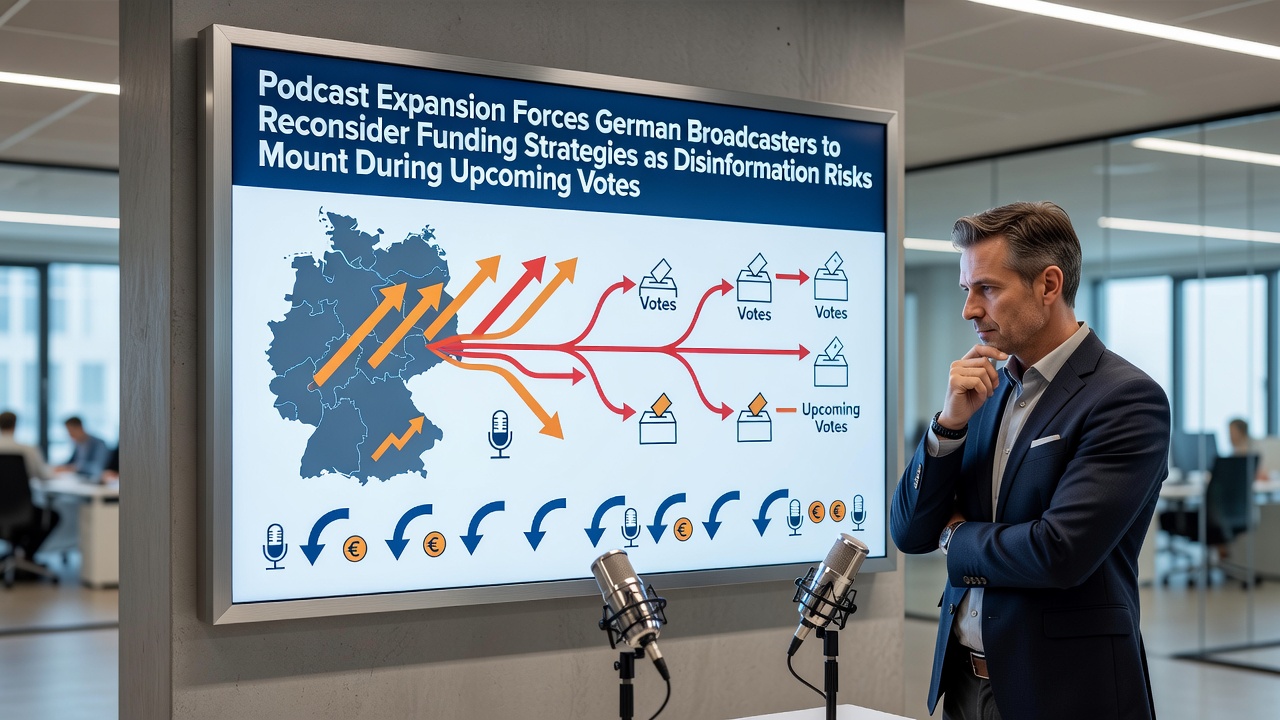
Podcast Expansion Forces German Broadcasters to Reconsider Funding Strategies as Disinformation Risks Mount During Upcoming Votes
Podcast listenership in Germany has grown steadily over the past five years, and public broadcasters now face pressure to adjust long-standing funding mechanisms that rely on household broadcasting fees collected through the GEZ system. Data from industry surveys show that on-demand audio formats captured a larger share of daily media consumption by 2025, while traditional linear radio audiences declined in several age groups. Broadcasters including ARD and ZDF have begun reallocating portions of their budgets toward podcast production and distribution platforms, yet the existing fee structure does not automatically scale with these shifts in consumption patterns.
Shifts in Audience Behavior and Revenue Allocation
Figures released by the Arbeitsgemeinschaft der Landesmedienanstalten indicate that podcast downloads and streams rose by double-digit percentages in multiple federal states between 2023 and 2025. Listeners increasingly access content through smartphone apps and smart speakers rather than scheduled broadcasts, prompting administrators to examine whether current contribution levels adequately cover expanded digital offerings. Several regional media authorities have opened consultations to explore tiered fee models that would tie contributions more directly to the volume and reach of on-demand services.
At the same time, private podcast networks have secured advertising partnerships with international brands, creating competitive pressure on publicly funded entities that operate under stricter advertising limits. Broadcasters report that they must now negotiate rights clearances and production partnerships more frequently to maintain relevance in a crowded audio marketplace.
Disinformation Concerns Ahead of 2026 Votes
October 2026 has been identified by several state election commissions as a period when multiple regional and local votes will occur, raising the stakes for content oversight. Reports compiled by the European Commission’s disinformation monitoring unit document an increase in audio-based narratives that circulate without the same editorial controls applied to television and radio programs. Podcasts distributed through independent platforms often lack the real-time fact-checking infrastructure maintained by established newsrooms, allowing misleading claims to reach targeted listener groups before corrections appear.

Researchers at the University of Oxford’s Internet Institute have tracked coordinated audio campaigns in several European countries and noted that similar tactics have appeared in German-language channels. Public broadcasters have responded by expanding internal verification teams and forming partnerships with independent fact-checking organizations to review high-impact episodes. These efforts require additional resources at a moment when overall funding discussions remain unresolved.
Regulatory and Institutional Responses
The Medienstaatsvertrag, the interstate treaty governing broadcasting, underwent amendments in 2024 that explicitly address digital audio services. Implementation guidelines now require public broadcasters to publish transparency reports on podcast funding sources and editorial standards. State media regulators in North Rhine-Westphalia and Bavaria have piloted audit frameworks that evaluate both reach metrics and content compliance, wth results scheduled for review in early 2026.
Industry associations representing both public and private audio producers have called for clearer definitions of what constitutes public-service podcast content eligible for fee support. Meetings held in 2025 produced draft criteria that emphasize educational value, regional relevance, and adherence to journalistic standards, yet final adoption depends on agreement among all sixteen federal states.
Resource Reallocation and Platform Partnerships
Broadcasters have begun testing co-production agreements with established podcast networks to share distribution costs while retaining editorial control. These arrangements allow access to larger audiences without proportional increases in in-house staffing. Data from pilot projects show mixed results: some series achieved higher download numbers, while others struggled with discoverability on third-party platforms that prioritize algorithmic recommendations over public-service mandates.
Technical investments in metadata tagging and content archiving have also risen, as institutions prepare for potential regulatory audits tied to the 2026 voting cycle. Archivists note that preserving audio episodes in formats compatible with future verification tools adds another layer of expense not originally anticipated under the current fee collection model.
Conclusion
German public broadcasters continue to navigate the tension between expanding podcast portfolios and maintaining sustainable funding structures while preparing for heightened scrutiny during the October 2026 votes. Ongoing consultations among media authorities, state governments, and production partners will determine whether revised fee allocations and content safeguards can keep pace with both audience migration and emerging disinformation vectors. The outcomes of these discussions will shape the operational landscape for audio public service media in the years ahead.